
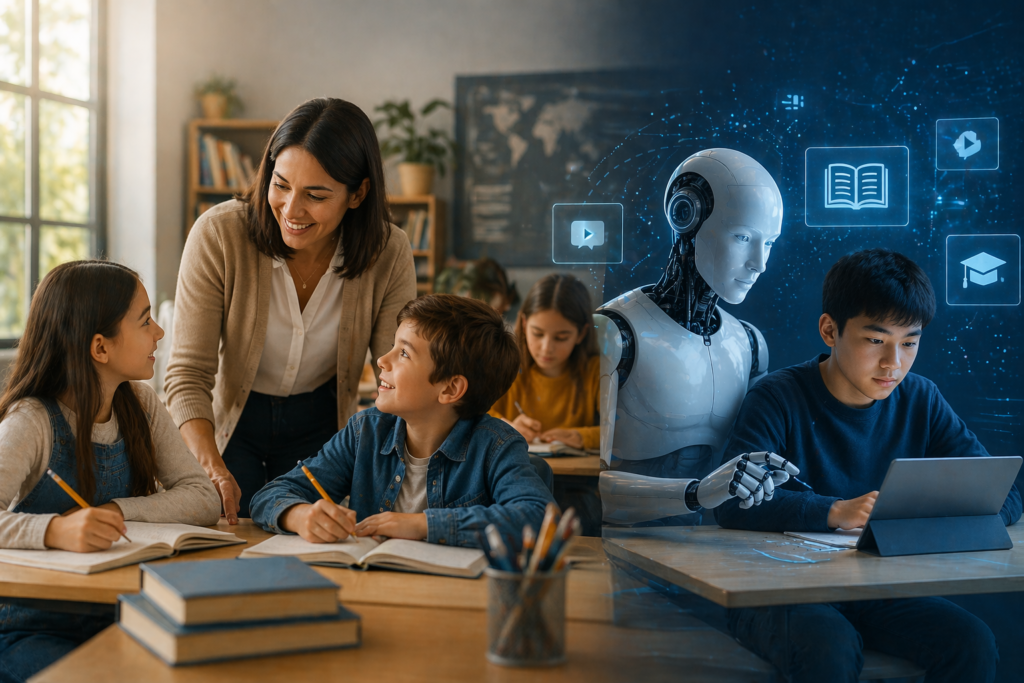
👾 The Sci-Fi Fantasy (or Nightmare?) of AI Classrooms
When people hear “AI in education,” they often imagine a futuristic classroom —
robots handing out grades, holographic tutors quoting Shakespeare, and students nodding along to hologram professors.
Sounds straight out of a Black Mirror episode, right?
As artificial intelligence becomes increasingly woven into schools through adaptive learning tools, AI tutors, and auto-grading systems, the big question keeps popping up:
Can AI actually replace teachers?
Let’s unpack this with honesty, curiosity, and a dash of sass — because while AI might understand what we’re learning, it still doesn’t quite get why we’re learning.
🧠 The Rise of Machine Learning in Education

Artificial Intelligence isn’t just a buzzword anymore — it’s a fundamental force in modern education.
From tools like ChatGPT and Khan Academy’s “Khanmigo” tutor to AI grading and predictive analytics, machine learning is now handling tasks that used to require entire academic departments.
AI can now:
-
Grade essays and quizzes instantly.
-
Identify student learning gaps through performance data.
-
Adapt learning paths based on strengths and weaknesses.
-
Translate lessons in real-time for multilingual learners.
-
Even simulate one-on-one tutoring at scale.
Pretty impressive, right?
For teachers buried in paperwork, AI is like a digital superhero — fast, efficient, tireless, and completely immune to caffeine shortages.
But before we crown it “Teacher of the Year,” let’s explore where AI truly shines… and where it falls flat.
⚡ What AI Does Better Than Humans
Let’s be real: there are things AI absolutely crushes — and they mostly revolve around speed, data, and scalability.
1. Personalization at Scale
AI never gets tired or distracted.
It can instantly adjust to each learner’s pace, difficulty level, and interests.
Think of apps like Duolingo or Coursera — they adapt dynamically based on your performance.
It’s basically the Spotify of learning, curating your next “lesson playlist” so you never get bored or lost.
2. Instant Feedback
Gone are the days of waiting two weeks for graded essays.
AI grading tools provide immediate responses — and not just “right or wrong.”
They can explain mistakes, suggest improvements, and reinforce weak concepts.
This instant loop of feedback supercharges learning — especially for coding, math, and grammar.
3. 24/7 Availability
AI tutors don’t need sleep, snacks, or weekends off.
Whether it’s 3 PM or 3 AM, students can get support instantly.
This global accessibility makes learning flexible for night owls, shift workers, or students in different time zones.
4. Data-Driven Insights
AI can analyze thousands of learning patterns simultaneously — spotting who’s struggling, which lessons flop, and even predicting dropouts before they happen.
For teachers, that’s like having an invisible assistant whispering,
“Hey, you might want to check on Sarah — she’s losing focus this week.”
It’s a game-changer for preventative education.
💔 But Here’s What AI Still Can’t Do
Here’s the kicker: AI might process data beautifully… but it doesn’t feel.
And emotion, in teaching, isn’t optional — it’s the foundation.
1. Emotional Intelligence
Teachers aren’t just knowledge dispensers — they’re emotional translators.
They notice when silence means confusion, when laughter masks anxiety, or when a student’s eyes quietly ask for help.
AI can simulate empathy, but it can’t feel it.
It can’t celebrate a child’s breakthrough, reassure a nervous teen, or sense that “I’m fine” really means “I’m not.”
Education without emotion is like Wi-Fi with signal but no connection — technically working, but useless in practice.
2. Moral and Social Guidance
Classrooms are not just academic spaces; they’re ethical ecosystems.
Teachers teach kindness, collaboration, and integrity — things that can’t be programmed into code.
AI can define morality but not embody it.
An AI-led classroom might run smoothly but feel empty — efficient yet soulless.
3. Spontaneity and Creativity
Ever had a teacher toss aside the textbook and tell a story that changed your outlook on life?
That’s human intuition at work — sensing the room, improvising, connecting dots AI can’t see.
AI can generate content but not context.
It doesn’t feel the pulse of a moment.
4. The Human Spark of Inspiration
Almost everyone remembers a teacher who believed in them before they believed in themselves.
That’s not data — that’s magic.
It’s the human spark that transforms “education” into “transformation.”
AI can gamify, reward, and motivate — but it can’t make a student feel seen.
⚖️ The Ideal Future: Collaboration, Not Competition
So maybe the real question isn’t “Will AI replace teachers?”
It’s “How can AI empower teachers?”
Think of AI as a calculator and teachers as mathematicians.
The calculator crunches the numbers, but the mathematician decides which numbers matter.
The classroom of the future isn’t man or machine — it’s man with machine.
Here’s what that looks like:
-
AI as the helper, not the dictator.
Automating grading and admin so teachers can focus on empathy and mentorship. -
AI tutors for extra support.
Students practice concepts outside class while human teachers provide emotional and intellectual grounding. -
Teachers as learning designers.
Creating stories, discussions, and experiences that AI can’t replicate. -
Hybrid classrooms.
Combining adaptive software with the irreplaceable power of human presence.
AI should lighten the workload — not take the soul out of teaching.
🧩 Case Study: When AI Meets Humanity
Meet Khanmigo, the AI tutor by Khan Academy powered by GPT.
It doesn’t just spit answers — it guides students step by step, mimicking a teacher’s thought process.
But here’s the twist: it’s built for teachers, not instead of them.
Teachers use it to create lesson plans, monitor student progress, and pinpoint where their human touch is most needed.
Similarly, Finland’s education system — often ranked #1 globally — uses AI to enhance, not replace, its teachers.
They rely on AI analytics, but the heart of their success?
Strong teacher-student relationships.
⚠️ What Happens If We Over-Automate
Let’s imagine the worst-case scenario: AI takes over everything.
Here’s what we risk losing:
-
Empathy: Students might memorize facts but forget compassion.
-
Bias: AI reflects its training data — and bias in means bias out.
-
Connection: Without real interaction, classrooms become transactional.
-
Critical Thinking: Students may become tool users, not problem solvers.
Technology without humanity becomes tyranny — efficient but empty.
❤️ The Human Advantage: Connection and Curiosity
From infancy to adulthood, humans learn socially.
We imitate, empathize, and grow through interaction.
That dance of emotion and cognition can’t be replicated by algorithms.
Teachers don’t just teach subjects — they teach life.
Through stories, compassion, humor, and vulnerability, they model what it means to be human.
AI might predict what you’ll learn next,
but only a teacher knows what you need to hear today.
✨ The Verdict: AI Can Teach — But It Can’t Touch
AI is the most powerful teaching tool ever created.
It can make learning faster, smarter, and more tailored than ever before.
But replace teachers? Nope.
Because learning isn’t about filling minds — it’s about shaping hearts.
AI may someday simulate empathy, but it’ll never feel it.
It can explain equations, but not comfort a student through failure or fear.
The teachers of tomorrow won’t be replaced — they’ll be reborn.
Freed from admin tasks, empowered by data, and more human than ever.
🏁 Conclusion: AI Can Teach Facts. Humans Teach Meaning.
Will AI replace teachers?
Technically, maybe.
Morally and emotionally? Never.
Learning is not a transaction — it’s a relationship.
Machines might learn faster, but humans teach what matters most:
purpose, compassion, and connection.
The strongest classrooms of the future will have AI doing the work,
and humans doing the hearts.
Because the truth is simple —
AI can teach facts.
But only humans can teach inspiration. ❤️