
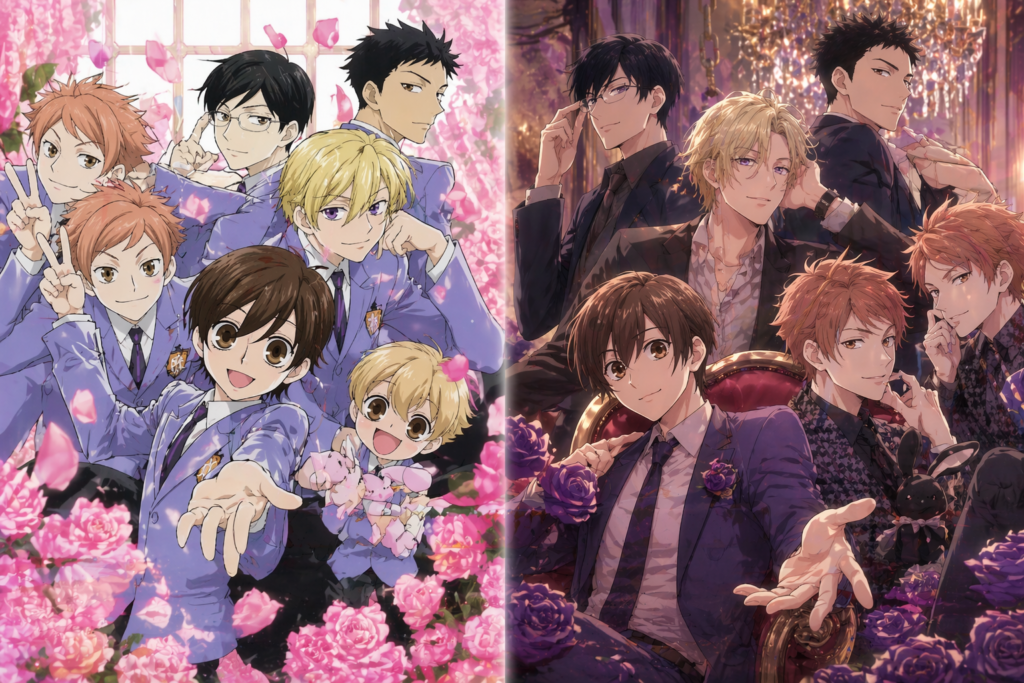
Ouran High School Host Club at Age 10 vs Now: The Anime That Hits Way Different as an Adult
There are two types of people in the world:
-
Those who watched Ouran High School Host Club as kids and thought it was just a funny anime
-
Those who rewatched it as adults and went, “Oh… this is actually unhinged genius.”
If you’re like me, you probably watched Ouran around age 10–12. Maybe on TV, maybe on a sketchy website with pop-up ads that tested your reflexes. Back then, it was peak comedy: rich boys, sparkles everywhere, and Haruhi casually existing while chaos followed.
But watching Ouran High School Host Club now?
Yeah. It’s a completely different experience.
Let’s talk about how this anime evolves with you—and why it’s somehow even better now than it was then.
Watching Ouran at Age 10: “Haha, Rich Boys Are Weird”
When we were kids, Ouran felt like a fever dream—in the best way.
You had:
-
A school that looked richer than your entire city
-
A club where boys literally got paid to flirt
-
Roses appearing out of thin air
-
Characters who were… loud. Very loud.
At age 10, the appeal was simple:
-
Tamaki was hilarious (dramatic? yes. annoying? also yes. iconic? absolutely)
-
The twins were chaos (and somehow that was enough)
-
Haruhi was cool because she didn’t care about anything
-
Honey-senpai was small and ate cake, which felt like peak character writing back then
We didn’t question the logic. We didn’t analyze themes. We just laughed.
And honestly? That was enough.
Ouran was comfort anime before we even knew what “comfort anime” meant. It was colorful, fast-paced, and didn’t take itself seriously—which, at that age, was exactly the vibe.
Rewatching Ouran Now: “Oh… This Is Smart”
Fast forward to now. You rewatch Ouran High School Host Club expecting nostalgia.
Instead, you get layers.
Suddenly, things hit different.
1. Haruhi Isn’t Just “Cool”—She’s Revolutionary
As a kid, Haruhi was “the girl who dressed like a boy.”
As an adult? Haruhi is quietly one of the most progressive anime protagonists of her time.
She doesn’t care about:
-
Gender roles
-
Class expectations
-
Social performance
Her famous line—“People are people”—isn’t just casual dialogue. It’s the thesis of the entire show.
She doesn’t reject femininity or masculinity; she just doesn’t let either define her. And for an anime released in 2006? That’s wild.
Ten-year-old you thought she was chill.
Adult you realizes she’s emotionally grounded, self-aware, and refreshingly unbothered.
Honestly? Haruhi aged like fine wine.
2. Tamaki Suoh Is Not Just Loud—He’s Deeply Lonely
Let’s be real: as kids, Tamaki was comic relief.
Now? He’s a walking trauma response wrapped in rose petals.
Tamaki:
-
Performs joy to mask abandonment
-
Builds a “family” because he didn’t have one
-
Is dramatic because he’s terrified of being unwanted
His obsession with making others happy suddenly feels less annoying and more… sad.
And the way he struggles to express real emotion? Yeah. That’s not comedy—that’s emotional repression with a laugh track.
Watching Tamaki now feels like watching someone who never learned how to be loved properly, trying his absolute best anyway.
Respect.
3. The Comedy Is Actually Satire (Who Knew?)
At age 10, you laughed with the show.
Now, you realize the show was laughing at itself the entire time.
-
The Host Club is a parody of romance tropes
-
The excessive wealth is intentionally ridiculous
-
The gender performance is exaggerated on purpose
Ouran doesn’t glamorize elite culture—it roasts it.
The rich students are absurd. Their problems are unserious. Their priorities are laughable. And Haruhi, the only “normal” person in the room, acts as the audience’s anchor.
Kid-you thought the sparkles were cool.
Adult-you realizes they’re satire turned up to eleven.
4. The Twins? Yeah… They’re Kind of Tragic
Let’s talk about Hikaru and Kaoru.
At age 10: “Omg twins! So mischievous! So fun!”
Now: “Oh no. These boys have serious identity issues.”
They:
-
Were treated as a single unit their whole lives
-
Struggled to be seen as individuals
-
Used manipulation as a defense mechanism
Their entire arc is about learning how to exist separately—and that’s actually heavy.
As kids, we didn’t catch that.
As adults, it’s impossible to miss.
5. Class Commentary Hits Harder Now
When you’re a kid, the rich school is fantasy.
When you’re an adult?
It’s commentary.
Haruhi constantly reminds us:
-
Wealth doesn’t equal worth
-
Privilege warps reality
-
Kindness means more than status
Her financial situation isn’t romanticized. It’s practical. She works. She studies. She survives.
Meanwhile, the elite students float through life insulated from consequences.
Watching this now, it’s hard not to see Ouran as a subtle critique of class divides—wrapped in comedy so it goes down easy.
Sneaky. Very sneaky.
Why Ouran Still Works Today
Here’s the thing: Ouran High School Host Club didn’t age perfectly.
Some jokes are dated.
Some humor wouldn’t fly today.
But the heart of the show? Still solid.
It’s about:
-
Found family
-
Identity
-
Acceptance
-
Choosing kindness in absurd systems
And those themes? Timeless.
If anything, watching it now feels more meaningful because we finally understand what it was trying to say.
Final Thoughts: Same Anime, New Brain
Watching Ouran High School Host Club at age 10 was fun.
Watching it now is rewarding.
It’s the kind of anime that grows with you—not because it changes, but because you do.
Back then, it made you laugh.
Now, it makes you think.
And somehow, it still feels like home.
Honestly? That’s the mark of a classic.
So if you’ve been debating a rewatch—do it.
Just be prepared to feel a little called out, a little emotional, and very aware that your taste was elite even as a child.
And yes… Tamaki is still extra.
But now we love him for it 🌹✨