
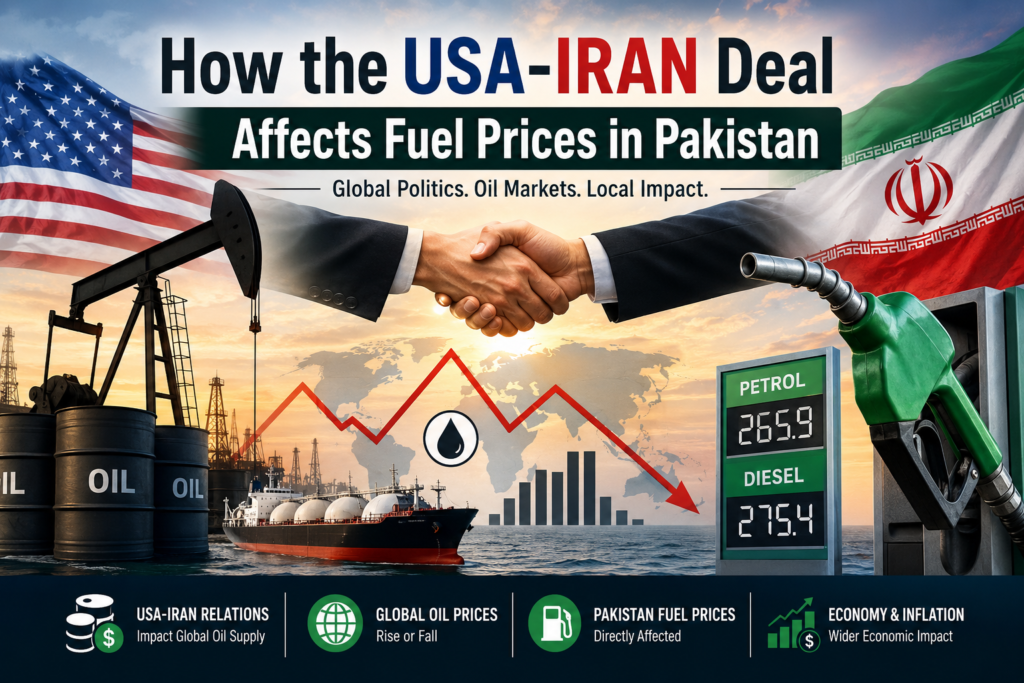
Fuel prices in Pakistan are heavily influenced by international events, especially developments in the Middle East. One of the most important geopolitical factors impacting global oil markets is the relationship between the United States and Iran. Whenever tensions rise or peace talks progress between these two countries, oil prices across the world react almost immediately.
This often leads Pakistanis to ask an important question: Does the USA-Iran deal affect fuel prices in Pakistan?
The answer is yes. Any agreement, conflict, or diplomatic breakthrough between the United States and Iran can significantly impact global crude oil prices, which directly affects petrol and diesel prices in Pakistan. Since Pakistan imports a large portion of its petroleum needs, even small fluctuations in international oil prices can influence inflation, transportation costs, and the overall economy.
In this article, we will explain how the USA-Iran relationship impacts global oil markets, why Pakistan is affected, and what consumers should expect when international tensions rise or fall.
Why Iran Matters in Global Oil Markets
Iran is one of the world’s major oil-producing countries and holds some of the largest crude oil reserves globally. It also controls access to the Strait of Hormuz, one of the most important oil shipping routes in the world.
Nearly 20% of global oil supply passes through the Strait of Hormuz. Because of this, any conflict or agreement involving Iran immediately impacts oil markets worldwide.
Whenever there are fears of war, sanctions, or shipping disruptions:
- Global oil prices usually rise
- Fuel supply concerns increase
- Energy markets become unstable
On the other hand, when the United States and Iran move toward peace talks or nuclear agreements:
- Oil prices often decline
- Supply expectations improve
- Global markets become more stable
This is why traders closely monitor every development involving the USA and Iran.
How the USA-Iran Deal Impacts Oil Prices
1. Sanctions on Iranian Oil Exports
The United States has imposed sanctions on Iran multiple times over the years. These sanctions restrict Iran’s ability to sell oil internationally.
When sanctions are active:
- Iranian oil exports decrease
- Global oil supply becomes tighter
- Crude oil prices often increase
However, when the United States signals a possible agreement with Iran or plans to ease sanctions, markets expect more Iranian oil to return globally. This usually pushes oil prices downward.
According to recent reports, potential agreements between the USA and Iran could allow millions of barrels of Iranian oil to re-enter global markets.
That increase in supply generally helps reduce international crude oil prices.
What Happens to Fuel Prices in Pakistan?
Pakistan imports most of its petroleum products using US dollars. Because of this, local fuel prices are directly connected to international crude oil prices.
If Oil Prices Rise Globally
When tensions increase between the USA and Iran:
- Global oil prices rise
- Pakistan’s import costs increase
- Petrol and diesel prices usually increase locally
This creates a chain reaction across the economy:
- Transport fares rise
- Food prices increase
- Inflation becomes worse
- Electricity generation costs may rise
Pakistan has experienced this multiple times during Middle East conflicts and oil supply disruptions.
If a USA-Iran Deal Happens
When peace talks progress or sanctions are lifted:
- Oil supply expectations improve
- Crude oil prices often fall
- Pakistan may get some relief in fuel pricing
For example, reports about a possible USA-Iran agreement recently pushed oil prices sharply lower because traders expected the reopening of oil supply routes and increased Iranian exports.
In theory, lower global oil prices should reduce petrol prices in Pakistan.
However, there is an important catch.
Why Petrol Prices in Pakistan Do Not Always Fall Quickly
Even when global oil prices decline, Pakistani consumers may not receive immediate or full relief.
This happens because fuel pricing in Pakistan depends on several additional factors:
- Petroleum levy
- Government taxes
- Dollar exchange rate
- Import costs
- IMF conditions
- Dealer and refinery margins
Sometimes the government increases petroleum levy when international oil prices decline. This helps increase tax revenue while keeping retail fuel prices relatively high.
So even if global crude oil prices fall:
- The government may collect more taxes
- Petrol prices may not decrease significantly
This is one of the biggest reasons why people often feel international oil price reductions do not fully benefit Pakistani consumers.
The Role of the Dollar Exchange Rate
Another major factor affecting fuel prices in Pakistan is the Pakistani rupee’s value against the US dollar.
Oil is traded globally in dollars. This means:
- A stronger dollar increases Pakistan’s import bill
- A weaker rupee makes fuel more expensive locally
Even if international oil prices decline after a USA-Iran agreement, Pakistan may still struggle to reduce fuel prices if the rupee depreciates heavily.
For example:
- Global crude prices fall by 10%
- But the rupee weakens by 15%
- Pakistan may still face higher import costs
This is why exchange rate stability is extremely important for controlling inflation and fuel prices.
Impact on Pakistan’s Economy
Fuel prices affect almost every sector of Pakistan’s economy.
Transportation Costs
Higher petrol and diesel prices increase:
- Public transport fares
- Freight charges
- Delivery expenses
This impacts businesses and consumers nationwide.
Inflation
Fuel price increases raise the cost of:
- Food
- Construction materials
- Manufacturing
- Agriculture
As transportation becomes expensive, businesses transfer additional costs to consumers.
Trade Deficit
Pakistan spends billions of dollars annually on oil imports. When global oil prices rise:
- The import bill increases
- Foreign exchange reserves come under pressure
- Economic stability weakens
A USA-Iran peace deal that lowers global oil prices could help Pakistan reduce its import burden.
Strait of Hormuz and Pakistan’s Fuel Security
The Strait of Hormuz is extremely important for Pakistan because much of the country’s imported oil passes through this route.
During conflicts involving Iran:
- Shipping risks increase
- Insurance costs rise
- Oil supply disruptions become possible
Recent reports showed that fears regarding the Strait of Hormuz significantly increased oil prices globally during periods of tension.
If stability returns to the region through diplomacy or peace agreements, oil transportation becomes smoother and markets usually calm down.
Can Petrol Prices in Pakistan Become Cheaper Permanently?
A USA-Iran deal may temporarily reduce global oil prices, but permanent fuel price relief in Pakistan depends on broader economic reforms.
Pakistan still faces several challenges:
- Heavy dependence on imported fuel
- Rupee depreciation
- High taxation on petroleum products
- Fiscal pressure from IMF programs
- Limited local energy production
To achieve long-term fuel stability, Pakistan may need to:
- Invest in renewable energy
- Improve public transportation
- Increase local refining capacity
- Reduce dependence on imported oil
Without structural reforms, Pakistan will remain vulnerable to global oil market shocks.
Future Outlook for Fuel Prices in Pakistan
Fuel prices in Pakistan will continue to react strongly to developments involving:
- USA-Iran relations
- Middle East conflicts
- Global oil supply
- OPEC decisions
- Dollar exchange rates
If diplomatic relations improve between the United States and Iran, global oil markets may stabilize and fuel prices could decline.
However, if tensions escalate again:
- Oil prices may rise sharply
- Pakistan’s import costs may increase
- Inflationary pressure may return
This is why international politics often directly impacts everyday fuel prices in Pakistan.
Conclusion
The USA-Iran relationship plays a major role in determining global oil prices, and those changes directly affect petrol and diesel prices in Pakistan. Since Pakistan imports most of its fuel, any increase or decrease in global crude oil prices immediately impacts the local economy.
When tensions rise between the USA and Iran, oil prices usually increase due to fears of supply disruptions. When peace talks or agreements progress, markets often respond positively and oil prices may decline.
However, Pakistan’s fuel prices are also influenced by petroleum levy, government taxes, IMF policies, and the dollar exchange rate. This means Pakistani consumers may not always receive immediate relief even when global oil prices fall.
As long as Pakistan remains dependent on imported petroleum products, international geopolitical developments will continue shaping fuel prices across the country.