
What do you picture when you think of “online learning”?
Maybe it’s clicking through a boring PowerPoint, listening to a teacher drone on, and resisting the temptation to switch to YouTube instead.
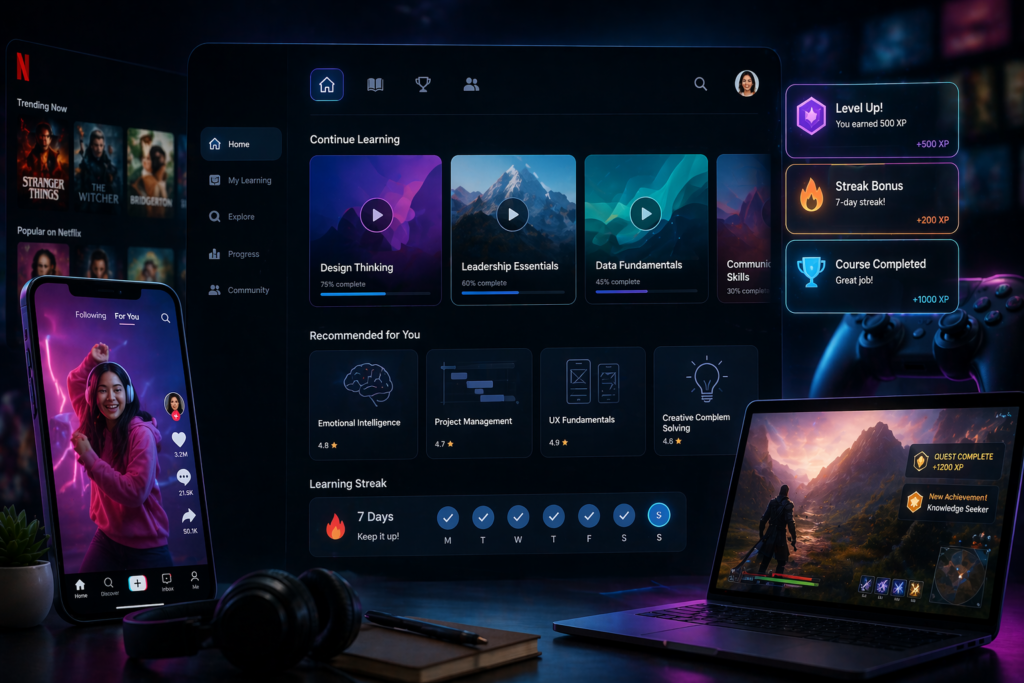
For decades, LMS (Learning Management System) platforms were useful — but not necessarily enjoyable. Then came Netflix, TikTok, and gaming — three digital giants that rewired how we consume, learn, and crave content.
Now, the next generation of LMS design isn’t trying to look like a virtual classroom anymore.
It’s trying to feel like entertainment.
Let’s break down how binge culture, short-form content, and interactive game mechanics turned dull e-learning into something people actually want to come back to.
🎥 The Netflix Effect: Binge-Learning & Seamless Design

Netflix doesn’t just stream movies — it curates experiences.
From the moment you log in, you’re greeted with sleek visuals, seamless transitions, and personalized recommendations like:
“Because you watched Stranger Things, you might like The Umbrella Academy.”
That psychological trick keeps you glued for hours — and LMS designers took notes.
The old “Unit 1, Unit 2, endless slides” model? Outdated.
The new era is about learning like you’re watching a Netflix show — short, serialized, and highly addictive (in a good way).
Each lesson becomes an “episode.” Each module becomes a “season.”
Gone is Chapter 3: Photosynthesis. Now it’s Episode 3: The Secret Superpower of Leaves.
Suddenly, curiosity replaces obligation.
Netflix also pioneered personalization. Imagine your LMS saying:
“Because you loved Digital Marketing Basics, try Copywriting for Conversions.”
That’s what next-gen platforms like Coursera Plus, 5Mins.ai, and MasterClass are already doing — using smart algorithms to recommend the next step.
Even design-wise, Netflix has shaped the look of modern LMS platforms: simple menus, crisp fonts, and effortless navigation.
No clutter, no confusion — just pure flow.
If you want people to learn, remove every reason they might click away.
📱 The TikTok Revolution: Microlearning & Attention Mastery

TikTok didn’t just create trends — it created a new way for our brains to process content.
Fifteen seconds. Catchy sound. Instant dopamine. Repeat.
What educators realized is that short doesn’t mean shallow.
You can teach a math trick, a mini recipe, or a language phrase in under a minute — and people actually remember it.
That’s where microlearning stepped in.
Instead of hour-long lectures, courses now deliver 2–5 minute “snack-sized” lessons, each laser-focused on one idea.
These bite-sized bursts of learning are perfect for the modern lifestyle — learn on the bus, in a coffee break, or while waiting for your Uber.
TikTok-style content is also shaping LMS visuals:
quick intros, captions, dynamic motion, background music — all designed to keep your attention rooted.
Even the social side of TikTok has inspired LMS updates. Imagine:
-
“Learning challenges” where students recreate lessons.
-
Teachers posting “reaction videos” to student submissions.
-
Discussion threads that feel more like community hubs than classrooms.
TikTok also made mobile mandatory.
Modern LMS systems now must feel as smooth on your phone as they do on your laptop — vertical video, swipe navigation, quick taps.
If it doesn’t work beautifully on a smartphone, it’s already behind.
🎮 The Gaming Impact: Motivation, Flow & Feedback Loops

Where Netflix makes learning consumable and TikTok makes it addictive, gaming makes it interactive.
Gamers will grind for hours to level up — not because they have to, but because the system rewards their effort.
That’s where gamification enters the LMS world.
Points, badges, streaks, and progress bars are now standard features.
They help learners see their progress.
Leaderboards create friendly competition. Levels and unlocks fuel curiosity.
“Finish this quiz to unlock the bonus challenge.”
But gamification isn’t just decoration — it’s psychology.
Games master the art of balancing challenge and reward. Too easy, and you’re bored. Too hard, and you quit.
LMS platforms now follow that same curve — small wins early, growing difficulty, instant feedback.
Perhaps the biggest lesson gaming taught education is this:
Failure is not the end. It’s part of the loop.
In games, failure is just data — a signal to try again.
In learning, it should be the same.
The best LMS designs now allow “safe failure” — you can mess up, learn, and retry without punishment.
And then there’s storytelling.
Great games don’t just have levels — they have quests.
Imagine your LMS as a story-driven adventure:
You’re not completing “Lesson 2.” You’re “unlocking your next mission in The Psychology Quest.”
Stories make facts stick, because humans remember narratives — not bullet points.
🌐 The Fusion: Where All Three Meet

Mix Netflix’s flow, TikTok’s speed, and gaming’s feedback — and you get a learning experience that’s irresistible.
Netflix brings structure and polish.
TikTok adds speed and accessibility.
Gaming contributes motivation and immersion.
Together, they build LMS systems that don’t push learning — they invite it.
Take 5Mins.ai, the “TikTok of workplace learning.”
It gives employees 2-minute micro-lessons with gamified rewards — resulting in 80%+ completion rates, unheard of in corporate e-learning.
Or Duolingo — a game disguised as a language app.
You learn not because someone told you to, but because you don’t want to lose your streak.
That’s the future: learning that motivates itself.
⚠️ The Real Talk: Pitfalls & Challenges
Of course, not every borrowed trick works perfectly.
Some “edutainment” platforms go overboard — too much fun, not enough substance.
If every lesson becomes a flashy 2-minute video, you risk creating infotainment instead of education.
Gamification can also flop if it’s hollow.
Badges mean nothing if the content is boring.
And the binge model? It’s great for shows, but cramming isn’t ideal for memory retention.
Smart LMS platforms now balance this with spaced repetition — spreading learning over time, using reminders and mini quizzes.
Lastly, accessibility.
High-quality video needs fast internet, and not everyone has that.
So inclusive design — captions, audio versions, low-data modes — isn’t optional; it’s essential.
🚀 The Next Frontier: Intelligent, Immersive & Human

The next generation of LMS won’t just copy entertainment — it’ll evolve it.
AI will personalize everything.
No more cookie-cutter courses — your LMS will analyze your pace, weaknesses, and interests to recommend what to learn next.
Virtual and Augmented Reality will make abstract subjects tangible.
Imagine exploring ancient Rome or walking through a 3D human cell.
That’s not sci-fi — it’s the next big wave in education tech.
And TikTok’s social spirit will return as collaborative learning.
Students will create, remix, and share lessons — turning learning into a conversation, not a lecture.
The best LMS designs of tomorrow will blend fun and focus, play and purpose, human creativity and machine precision.
💡 Closing Thoughts
The future of learning is entertainment with intent.
Netflix showed us how to keep watching.
TikTok taught us how to make every second count.
Gaming taught us how to stay motivated.
Together, they’ve made education something beautiful — not a duty, but an experience.
Gen Z doesn’t just want to learn — they want to live it.
The LMS platforms that thrive won’t look like classrooms.
They’ll look like stories, journeys, and interactive worlds.
So maybe the question isn’t:
“How do we make learning more engaging?”
Maybe it’s:
“How do we make learning so natural that students forget they’re even in a system?”
That’s the Netflix–TikTok–Gaming hat trick.
And it’s revolutionizing education as we know it.