
Introduction
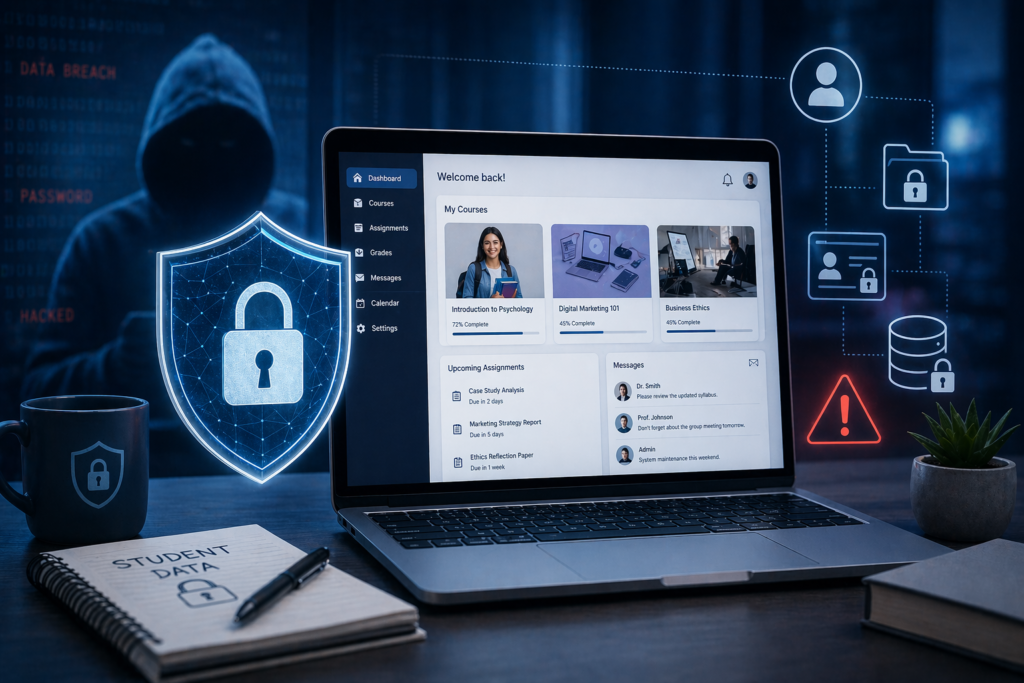
As of October 12, 2025, e-learning is a pillar of education, with millions of students depending on Learning Management Systems (LMS) to take courses, turn in assignments, and interact with educators. The ease of online platforms such as Moodle, Canvas, and Blackboard has transformed learning, but it has also brought substantial cybersecurity threats. Since student information—from contact details to grades—is kept in digital form, one is left wondering: is your LMS compromising student data? This blog explores the cybersecurity issues in e-learning, weaknesses of LMS platforms, and what stakeholders can do to protect sensitive data.
The Rise of E-Learning and Data Sensitivity
Global adoption of e-learning, prompted by the COVID-19 pandemic, has witnessed increased LMS adoption. By 2025, the e-learning market will reach more than $400 billion, indicating its broad penetration. These platforms hold enormous amounts of sensitive information, such as names, email addresses, grades, and even credit card data for paid courses. For the students, this information isn’t academic information—it’s personal and vulnerable to exploitation. A data breach could result in identity theft, financial loss, or academic fraud, making cybersecurity an urgent issue in the virtual classroom.
Popular Cybersecurity Threats in E-Learning
Data Breaches
Data breaches pose a significant threat to LMS platforms. Hackers attack these systems to steal personal data, which can be used on the dark web. Within 2024 alone, numerous high-profile breaches exposed the data of thousands of students, demonstrating the vulnerability of inadequately secured systems. Unpatched software or weak encryption tend to provide the entry point for such attacks.
Phishing Attacks
Phishing is a widespread threat, with attackers emailing or messaging students falsely as LMS administrators. Students might inadvertently share login credentials, granting hackers access to the system. The psychological approach of urgency—painting a password reset as urgent—is taking advantage of trust and ignorance, so this is a frequent vector for compromise.

Malware and Ransomware
Malware, including ransomware, is a substantial threat to the e-learning context. Malware can encrypt files or lock data once it has entered an LMS, with payment being requested for release. In 2023, a university LMS was taken hostage, impacting courses for several weeks. Institutions and students both are threatened with downtime and data loss, making effective defenses imperative.
Insider Threats
Insider threats, whether blatant or unintentional, also compromise security. A staff member who has access to the LMS can abuse data, or a student can pass on login credentials, opening up vulnerabilities. Human mistake, such as opening malicious links, is still an ongoing concern among these breaches.
LMS Platform Vulnerabilities
Out-of-date Software
Most LMS tools operate on out-of-date software, making them vulnerable to previously identified exploits. Patches are issued to fix security vulnerabilities by developers, but institutions or users might put updates off due to compatibility issues or a lack of resources. This delay provides an opportunity for attackers to launch their attack.
Weak Authentication
Weak authentication methods, e.g., weak passwords or absence of multi-factor authentication (MFA), are a prevalent vulnerability. Without MFA, stolen passwords can provide instant access, skipping other security measures. Only 60% of LMS platforms as of 2025 require MFA, leaving a wide gap.

Third-Party Integrations
LMS platforms have a tendency to integrate with third-party tools—payment gateways, video conferencing, or analytics software. Every integration creates a potential vulnerability if the security at the third party is weak. One weak point can destabilize the whole system, a risk compounded by the complexity of today’s e-learning systems.
Lack of Encryption
Data in transit and in rest need to be encrypted so as to avoid being intercepted. Some LMS platforms still employ weak or obsolete encryption protocols, leaving data readable by attackers. This is especially so for mobile applications, where encryption requirements differ.
The Psychological Impact of Data Breaches
A breach of cybersecurity goes beyond the technical loss—it has a psychological impact on students. Victims can feel anxious, lose confidence in online systems, or fear that their identity will be stolen. Loss of academic integrity, like compromised exam answers, also undermines confidence. Institutions lose reputation, resulting in declined enrollment and legal exposures. Picturing this human factor is important to rectify the larger issues of LMS vulnerabilities.
Regulatory Landscape
Governments and education agencies have reacted with legislation to safeguard student information. In the European Union, the General Data Protection Regulation (GDPR) has high fines for non-compliance, and in the United States, there is the Family Educational Rights and Privacy Act (FERPA). Non-compliance as of 2025 can attract fines of more than $20 million or 4% annual turnover, forcing institutions to keep cybersecurity at the top of their agendas. Enforcement is uneven worldwide, however, leaving some areas with lower protections.

Best Practices for the Security of LMS Platforms
Regular Patching and Updates
Institutions should ensure that LMS software is updated on a regular basis to fix security loopholes. Automated patch management tools help ensure this is done with less human error. A proactive update schedule according to vendor guidelines is necessary to be ahead of the threats.
Use of Multi-Factor Authentication
MFA introduces a level of protection against evil twin attacks, demanding a second means of validation—like a text message code or a biometric check. By 2025, MFA is advised by specialists as a matter of course, with rates of adoption to reach 80% within the foreseeable future.
Strong Encryption Standards
With strong encryption, like AES-256 for stored data and TLS 1.3 for transmitted data, information is secure from unauthorized access. Colleges should validate their LMS to ensure compliance with existing standards, especially for cloud-based and mobile systems.
Employee and Student Training
Education is a strong counter to cyber threats. Consistent training in identifying phishing, employing strong passwords, and reporting unusual activity minimizes the risk. Quarterly simulated phishing exercises improve awareness and resilience.
Vendor Accountability
LMS providers should be held accountable for security. Institutions need to examine vendor security policies, require regular audits, and include breach response provisions in agreements. A 2024 guideline by the International Association of Privacy Professionals maintains shared responsibility between users and vendors.
The Role of Artificial Intelligence
Artificial intelligence (AI) is revolutionizing LMS cybersecurity. AI-powered tools are capable of detecting anomalies, like irregular login behavior, and acting in real-time. Predictive algorithms based on machine learning anticipate possible threats, allowing action to be taken beforehand. By 2025, AI integration on LMS platforms is on the rise, with 35% more adoption this year reported. Yet, dependence on AI is best controlled to prevent false alarms or over-reliance on automated solutions.

Future Trends in E-Learning Cybersecurity
The future of e-learning cybersecurity is in cutting-edge technologies and cooperation. Blockchain might protect student records with immutable ledgers, and zero-trust architecture—authenticating all users—can become the norm. Global collaboration to unify security protocols will also be more effective. Experts estimate that by 2030, breaches on LMS will diminish to 50% if trends keep up.
Case Studies
Successful Mitigation
A mid-sized university put in place MFA and AI surveillance in 2023 and foiled a phishing attack on 5,000 students. The anticipatory steps prevented the organization from losing a possible $1 million and maintaining trust.
Lessons from Failure
On the other hand, a 2024 data breach at a community college compromised 10,000 student records because of old software. The breach cost $2 million in fines and remediation, emphasizing the price of complacency.
Conclusion
E-learning cybersecurity is an important concern impacting students, teachers, and institutions. LMS systems, as revolutionary as they have become, carry vulnerabilities such as data breaches, phishing, malware, and insider threats through outdated software, poor authentication, third-party integrations, and weak encryption. The psychological impact of breaches, along with the weight of regulation, emphasizes the need for immediate action. Implementing best practices—periodic updates, MFA, robust encryption, training, and vendor responsibility—can safeguard student data for stakeholders. As the future is defined by AI and breakthrough technologies, an active and symbiotic approach will make e-learning continue to be an effective and safe learning platform. Is your LMS secure? The time for evaluation and action is now.