
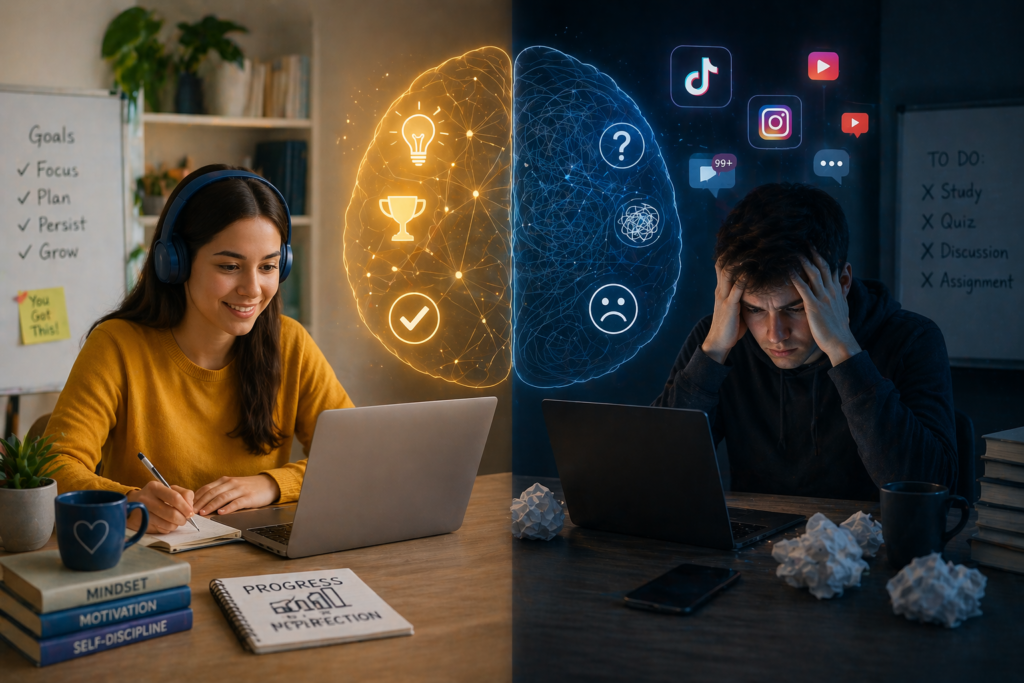
🧠 The Psychology of Online Learning: Why Some Students Succeed and Others Fail
When online learning initially gained popularity, everyone imagined it would be a win-win: convenience, comfort, and freedom — what’s not to love? But as the world tuned in to Zoom classrooms, one thing emerged: while some students excelled, others struggled just to make it.
So, what is the difference between the ones that thrive in the online classroom and the ones who burn out? Guess what? It’s not merely about the strength of Wi-Fi connection (although that certainly can help). It’s psychologically rooted — motivation, mindset, personality, environment, and even self-image.
Let’s break down the psychological game of online learning — the why of success and failure.
🎯 1. Motivation: The Invisible Engine
Consider motivation as the fuel that powers a student’s learning experience. Without it, even the most elaborate learning platform is a drag.
In classrooms, motivation tends to be external — the encouragement of a teacher, the social energy of peers, or a touch of friendly competition. Online, that structure disappears. Students are left with what psychologists refer to as intrinsic motivation — the inner propulsion to learn for its own sake.
🧍♂️ The Thrivers
Successful students are also big on autonomy — they like to be in control of how fast they work and what they work on. They frequently make personal commitments (“I will learn this in two weeks”) and give themselves treats for progress. They see learning as an investment, something that will pay off later.
😩 The Strugglers
On the other hand, learners who rely on outside gratification — grades, approval, or reminders — tend to find digital learning emotionally exhausting. In the absence of in-person structure, procrastination becomes the default.
💡 Psych Tip:
Self-determination theory (Deci & Ryan, 1985) explains that motivation thrives when three needs are satisfied — autonomy, competence, and relatedness. Online students who can meet these — through goal setting, small victory celebrations, and building relationships with classmates — are likely to remain energized.
🧩 2. Personality and Learning Style
Personality is a subtle but influential factor in achieving success online.
🌱 The Self-Starters
Introverts tend to excel in online classrooms. With no pressure of social performance or public speaking, they can absorb information quietly and engage on their own terms — via discussion boards or private reflection.
Independent learners love it too. They like to figure things out solo and are naturally inclined toward self-regulation — the ability to plan, focus, and tune out distractions.
🗣️ The Social Learners
Extroverts and social learners, though, might find online setups emotionally isolating. Without face-to-face dynamics, they lose energy. The absence of real-time feedback and physical cues can make learning feel robotic or disconnected.
🫶 One student might be thinking, “Finally, I can learn in peace.”
While another sighs, “I miss the buzz of the classroom.”
That’s the central psychological divide: some find solitude freeing, others find it suffocating.
🧘♀️ 3. Discipline and Self-Regulation
This is the tough truth: online learning puts your discipline under a microscope. No hovering teacher, no peer pressure, no “bell schedule.” Just you, your computer, and your self-control.
Successful students are generally self-regulated learners. They set study times, avoid distractions, and track their progress. They’re not perfect — they just bounce back when they slip.
Struggling students often underestimate the mental stamina required for self-paced study. They fall into the “I’ll do it later” trap, which leads to guilt, overwhelm, and burnout.
📊 A study from the Journal of Educational Psychology found that self-regulation predicts online learning success better than intelligence or prior grades. That’s huge.
💬 Self-regulation is basically being your own instructor — which sounds great until you realize your instructor is also kinda lazy sometimes. 😅
🧠 4. The Cognitive Load Problem
Ever opened a learning website, clicked on a video, and then ended up scrolling Instagram five minutes later? Yeah, that’s cognitive overload in action.
Our brains only hold so much information before they shut down. Online learning platforms — with notifications, hyperlinks, and endless tabs — flood the mind with stimulation.
🧩 The Adapters
Successful students know how to curate their learning space. They take notes, focus on one task at a time, and use techniques like Pomodoro (25 minutes work, 5 minutes rest) to stay sharp.
⚠️ The Overwhelmed
Those who multitask — watching lectures while texting, snacking, or browsing — often experience shallow understanding and poor retention.
🧠 John Sweller’s Cognitive Load Theory explains it best: learning sticks when information is digested in small, manageable chunks. The secret? Intentional focus.
🤝 5. The Social Connection Factor
Humans are wired for connection — even independent learners crave belonging. When that’s gone, motivation and engagement drop fast.
💬 Why It Matters
Social presence — the feeling that real people are learning alongside you — boosts confidence and persistence. Group projects, chats, and casual discussions recreate a sense of classroom community.
🧍♀️ The Lonely Learner Effect
When students feel invisible or disconnected, they disengage. This is the “online learning isolation effect.” Once that happens, catching up becomes a mental marathon.
Thriving learners actively build connections — joining study groups, commenting in discussions, messaging peers. Struggling learners withdraw silently, hoping to “figure it out alone,” which only deepens frustration.
💭 6. Mindset: Growth vs. Fixed
At the heart of learning psychology lies mindset, a concept popularized by Dr. Carol Dweck.
🚀 Growth Mindset Learners
They believe intelligence and ability can grow. When faced with difficulty, they ask, “What can I learn from this?” They adapt rather than quit.
🪨 Fixed Mindset Learners
They see ability as static — you either “get it” or you don’t. When learning gets tough, they interpret struggle as failure.
The difference? Thriving learners expect discomfort and see it as part of growth. Fixed-mindset learners avoid it, fearing it means they’re not capable.
Without real-time feedback, that fixed mindset can spiral into self-doubt.
🏡 7. The Environment Equation
You can’t talk about online learning without mentioning environmental psychology — how surroundings affect attention and emotion.
🌤️ The Focus-Friendly Space
Students who carve out a dedicated study zone — even a small desk — train their brains to switch into learning mode. Lighting, posture, and minimal noise improve engagement.
🌪️ The Chaos Factor
Others study from bed or noisy places. The brain associates that space with relaxation, not productivity, and focus drops.
🪴 TL;DR: Your workspace should say “Let’s get this bread,” not “Let’s nap.”
🖼️ Image suggestion: Cozy, minimalist study setup vs. messy, cluttered bed scene.
💚 8. Emotional Resilience and Mental Health
Online learning isn’t just intellectual — it’s emotional. Loneliness, screen fatigue, and anxiety can quietly crush motivation.
Thriving students practice emotional regulation — taking breaks, asking for help, keeping routines. They don’t let one bad day ruin the week.
Struggling students often internalize frustration (“I’m just bad at this”), when in reality, it’s stress or burnout talking.
💚 Mental health is the invisible backbone of learning — and online education makes it easier than ever to overlook.
🌟 9. So, How Can Online Learners Thrive?
Here’s a quick psychology-backed survival kit for online learners:
✅ Set micro-goals. Reward small wins.
✅ Create structure. Schedule, notes, deadlines.
✅ Stay social. Join communities or group chats.
✅ Focus intentionally. One tab at a time.
✅ Adopt a growth mindset. Struggle = learning.
✅ Protect your environment. Quiet space, comfy chair.
✅ Check in with yourself. Burnout is real.
🧭 Final Thoughts
Online learning isn’t just a technological shift — it’s a psychological test. It reveals your habits, mindset, and emotional endurance like never before.
The students who succeed aren’t necessarily the brightest — they’re the ones who understand themselves. They know when to push, when to rest, when to reach out, and when to shut down.
So, the next time someone says, “Online education doesn’t work,” remind them —
✨ It’s not the medium. It’s the mindset.