
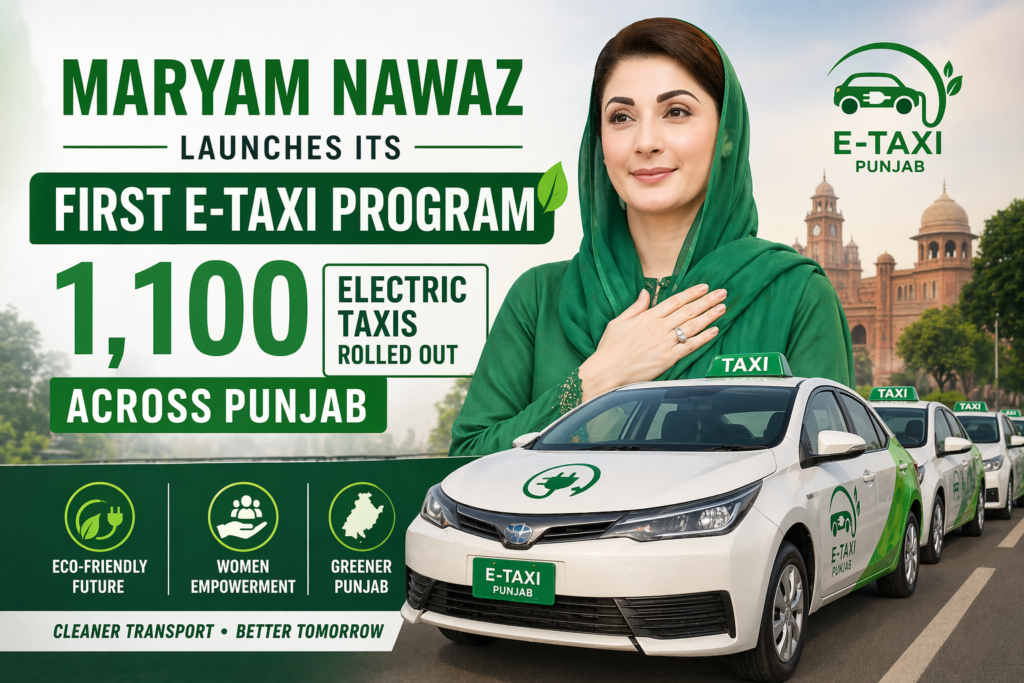
Punjab has officially stepped into the future of transportation. In a landmark move toward clean energy and sustainable urban mobility, Maryam Nawaz has launched Punjab’s first-ever E-Taxi Program, introducing 1,100 electric taxis across the province.
This initiative marks a major shift in Pakistan’s transport policy—combining environmental responsibility, economic opportunity, and modern infrastructure under one bold vision. The E-Taxi Program is not just about electric vehicles; it is about transforming public transport, reducing pollution, and creating new livelihoods.
A Historic Step for Punjab’s Transport Sector
The launch of the E-Taxi Program is being hailed as a historic milestone for Punjab, a province that faces increasing challenges related to air pollution, fuel costs, and urban congestion.
By introducing electric taxis, the Punjab government has taken a clear stance in favor of clean energy, reduced dependence on imported fuel, and smarter urban planning. This is the first structured attempt in Pakistan to deploy electric vehicles specifically for public and commercial transport on a large scale.
Simply put: this is not a trial balloon—it’s a real rollout.
Vision Behind the E-Taxi Program
The vision driving this initiative is multi-dimensional. It focuses on:
-
Reducing carbon emissions
-
Cutting fuel import costs
-
Providing affordable transport options
-
Creating employment opportunities
-
Modernizing Punjab’s transport infrastructure
Under Maryam Nawaz’s leadership, the Punjab government has emphasized green governance, and the E-Taxi Program fits squarely within that agenda.
Electric mobility is no longer a “future idea.” Punjab just made it official.
Why Electric Taxis? Understanding the Need
Punjab’s major cities struggle with rising smog levels, traffic congestion, and fuel price volatility. Traditional petrol and diesel vehicles are a major contributor to:
-
Air pollution
-
Noise pollution
-
Rising transport fares
-
Environmental degradation
Electric taxis address these issues head-on.
Key Advantages of Electric Taxis
-
Zero tailpipe emissions
-
Lower operating costs compared to fuel vehicles
-
Quieter rides, improving urban living
-
Reduced maintenance expenses
In short, electric taxis are cheaper to run, cleaner for the environment, and better for passengers.
Key Features of the Punjab E-Taxi Program
The initial phase of the program includes 1,100 electric taxis, carefully planned to ensure efficiency, accessibility, and sustainability.
Program Highlights
-
Deployment across major cities of Punjab
-
Environment-friendly electric vehicles
-
Affordable leasing or ownership models
-
Government-backed infrastructure support
-
Focus on public and commercial usage
This rollout is designed to be scalable, meaning the number of electric taxis can increase significantly in the future.
Economic Opportunities for Drivers and Youth
One of the most impactful aspects of the E-Taxi Program is its potential to generate employment and income opportunities, especially for young people.
How the Program Supports Livelihoods
-
Reduced fuel expenses increase driver profit margins
-
Structured financing models make ownership easier
-
Stable demand for taxi services ensures steady income
-
Skill development related to EV operations
For many drivers, fuel costs eat up a massive chunk of daily earnings. Electric taxis flip that equation.
Lower costs = higher take-home income. Simple math. Big impact.
Reducing Punjab’s Carbon Footprint
Environmental sustainability is at the heart of this initiative. Transport emissions are a major contributor to climate change and urban smog.
By shifting from fuel-based taxis to electric ones, Punjab can achieve:
-
Significant reduction in CO₂ emissions
-
Improved air quality in urban centers
-
Lower health risks related to pollution
-
Progress toward climate commitments
This program aligns with global trends where governments are transitioning toward green transport systems.
Punjab is finally catching that wave.
Infrastructure Development and Charging Stations
No electric vehicle program can succeed without reliable charging infrastructure—and the Punjab government knows this.
Infrastructure Plans Include
-
Installation of EV charging stations in major cities
-
Strategic placement near commercial hubs
-
Public-private partnerships for expansion
-
Future integration with renewable energy sources
Building this ecosystem ensures that electric taxis are practical, reliable, and scalable.
No chargers = no EV success. Punjab didn’t miss that memo.
Public Response and Market Confidence
The launch of the E-Taxi Program has generated strong public interest, especially among:
-
Ride-hailing drivers
-
Transport unions
-
Environmental advocates
-
Urban commuters
This initiative also sends a positive signal to investors and manufacturers, showing that Pakistan—particularly Punjab—is open to electric mobility investments.
Confidence attracts capital. Capital builds momentum.
Challenges and Realities to Address
While the program is promising, it is not without challenges.
Potential Issues
-
Initial cost of electric vehicles
-
Limited charging infrastructure in early stages
-
Public awareness and trust
-
Technical training for maintenance
However, these challenges are common in all countries transitioning to EVs. With proper policy support and phased implementation, they are manageable.
Progress doesn’t require perfection—it requires persistence.
Long-Term Impact on Punjab’s Transport System
If expanded successfully, the E-Taxi Program could:
-
Reshape urban transport in Punjab
-
Encourage private EV adoption
-
Reduce reliance on fossil fuels
-
Improve public health outcomes
-
Position Punjab as a regional green-transport leader
This initiative could become a blueprint for other provinces in Pakistan.
First mover advantage? Secured.
Leadership and Policy Direction
Maryam Nawaz’s decision to launch Punjab’s first E-Taxi Program reflects a governance style focused on modern solutions, sustainability, and economic inclusion.
Rather than short-term fixes, this program represents a structural shift in how public transport is planned and delivered.
Policy + execution = real change.
Conclusion
The launch of Punjab’s first E-Taxi Program, featuring 1,100 electric taxis, is more than a transport initiative—it is a statement of intent.
Under Maryam Nawaz’s leadership, Punjab is moving toward cleaner cities, smarter mobility, and inclusive economic growth. While challenges remain, the foundation has been laid for a greener and more sustainable transport future.
If scaled effectively, this program could redefine public transportation in Pakistan and set a new standard for environmentally responsible governance.
One thing is clear: Punjab just plugged into the future ⚡🚕