
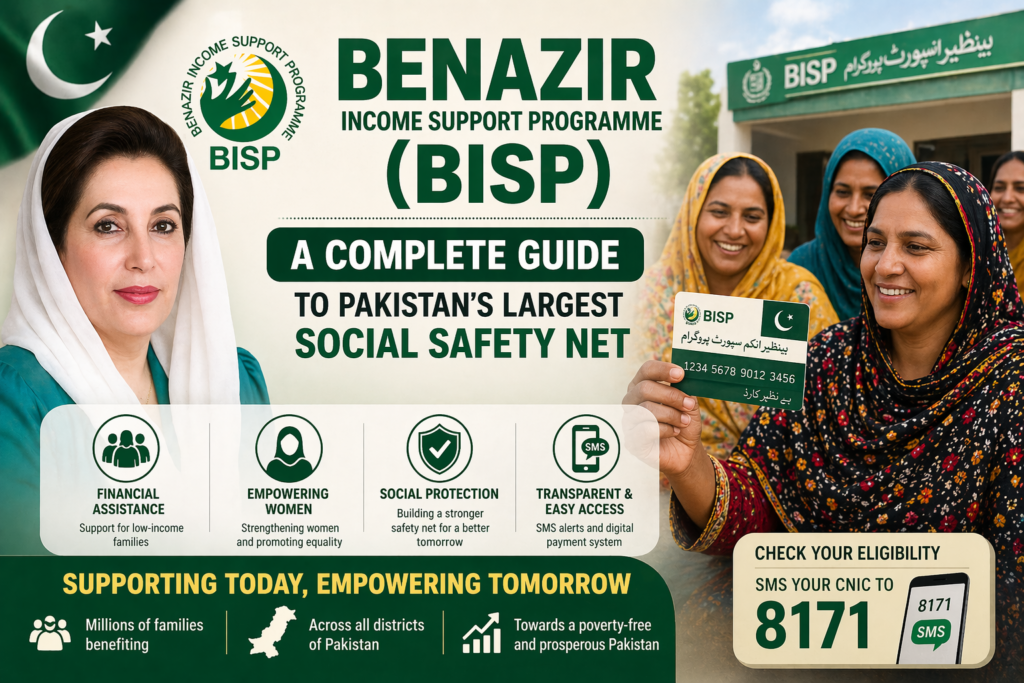
Poverty remains one of the most pressing challenges in Pakistan, especially during times of rising inflation, unemployment, and economic uncertainty. To support vulnerable families and provide financial relief, the Government of Pakistan launched the Benazir Income Support Programme (BISP)—the country’s largest social protection initiative.
Since its inception, BISP has played a critical role in supporting millions of low-income households, particularly women. This article provides a complete, easy-to-understand overview of BISP, including its objectives, eligibility criteria, benefits, registration process, and overall impact on Pakistani society.
What Is the Benazir Income Support Programme (BISP)?
The Benazir Income Support Programme is a federal cash assistance program designed to reduce poverty and provide financial stability to Pakistan’s poorest households. It was launched in 2008 and named after Benazir Bhutto, honoring her vision of social justice and support for marginalized communities.
BISP provides direct cash transfers to eligible families so they can meet basic needs such as food, healthcare, and education—without intermediaries.
Why Was BISP Launched?
Pakistan has long struggled with income inequality and poverty, especially among rural populations and urban informal workers. BISP was introduced to:
-
Protect low-income families from economic shocks
-
Reduce extreme poverty
-
Empower women financially
-
Promote social inclusion
-
Improve living standards at the household level
Instead of charity-based aid, BISP focuses on rights-based social protection, ensuring dignity and transparency.
Key Objectives of BISP
The core objectives of the Benazir Income Support Programme include:
-
Providing financial assistance to the poorest families
-
Ensuring women empowerment by making women the primary beneficiaries
-
Supporting education and health through conditional programs
-
Creating a transparent, data-driven welfare system
-
Reducing intergenerational poverty
This makes BISP more than just financial aid—it’s a long-term poverty reduction strategy.
Who Is Eligible for BISP?
Eligibility for BISP is determined through a nationwide poverty assessment system known as the National Socio-Economic Registry (NSER).
Basic Eligibility Criteria
You may qualify for BISP if:
-
Your household income falls below the poverty threshold
-
You possess a valid CNIC issued by NADRA
-
You are not a government employee
-
You do not own significant property or vehicles
-
You are not receiving benefits from other major government welfare schemes
Priority Groups
Special preference is given to:
-
Widows and divorced women
-
Women-led households
-
Persons with disabilities
-
Elderly individuals with no stable income
Pro tip: BISP is very women-centric by design, and honestly, that’s one of its strongest features.
How Does the BISP Registration Process Work?
Registration and verification are simple and accessible.
Step-by-Step Registration
-
Visit a BISP Registration Center
-
Participate in the NSER survey
-
Provide CNIC and household information
-
Data is verified through NADRA
-
Eligible families are enrolled
CNIC Verification via SMS
Applicants can also check eligibility by sending their CNIC number (without dashes) to 8171. If you’re eligible, you’ll receive confirmation along with payment details.
Low effort. High impact.
BISP Cash Assistance: How Much Do Beneficiaries Receive?
BISP provides quarterly cash payments, which are revised periodically to adjust for inflation.
Payment Highlights
-
Payments are made every three months
-
Funds are transferred through banks, ATMs, or designated payment centers
-
Beneficiaries receive SMS notifications before disbursement
The exact amount may change over time, but the goal remains the same: help families survive rising costs of living.
Major Programs Under BISP
BISP isn’t just one program—it’s a whole ecosystem of support initiatives.
1. Kafalat Program
This is the flagship unconditional cash transfer program, providing direct financial support to women.
2. Taleemi Wazaif
A conditional cash transfer initiative encouraging children’s education, especially for girls. Families receive additional stipends if children attend school regularly.
3. Nashonuma Program
Focused on maternal and child nutrition, this program supports pregnant women and young children to reduce stunting and malnutrition.
These sub-programs turn BISP from a survival tool into a development engine.
Impact of BISP on Pakistan’s Economy and Society
The impact of BISP has been massive and measurable.
Social Impact
-
Millions of families lifted above extreme poverty
-
Improved school enrollment rates
-
Increased financial independence for women
-
Better nutrition outcomes for children
Economic Impact
-
Increased household purchasing power
-
Strengthened local economies
-
Reduced reliance on informal debt
International organizations have recognized BISP as one of South Asia’s most effective social protection programs.
Big W for Pakistan, not gonna lie.
Transparency and Digital Transformation
One of BISP’s strongest points is its shift toward digital transparency.
-
Biometric verification
-
Direct bank transfers
-
Centralized databases
-
SMS-based updates
These measures help reduce corruption and ensure funds reach the right people.
Is it perfect? No. Is it improving? Definitely.
Common Challenges Facing BISP
Despite its success, BISP faces some challenges:
-
Data update delays
-
Limited awareness in remote areas
-
Payment distribution issues in some regions
-
Inflation reducing the real value of stipends
The government continues to address these issues through reforms and system upgrades.
Future of the Benazir Income Support Programme
The future roadmap for BISP includes:
-
Expanding coverage
-
Increasing cash assistance amounts
-
Integrating digital wallets
-
Enhancing grievance redressal systems
-
Linking beneficiaries to skills and employment programs
The goal is to move families from dependency to self-sufficiency.
That’s the dream.
Conclusion
The Benazir Income Support Programme is more than a welfare initiative—it’s a lifeline for millions of Pakistani families. By providing direct financial support, prioritizing women, and promoting transparency, BISP has reshaped how social protection works in Pakistan.
In a country where economic shocks are frequent, programs like BISP are not optional—they’re essential.
If strengthened and expanded, BISP has the potential to break the cycle of poverty and create a more inclusive future for Pakistan.
vglssessrxedogfxyxdlkeojsufnpe