
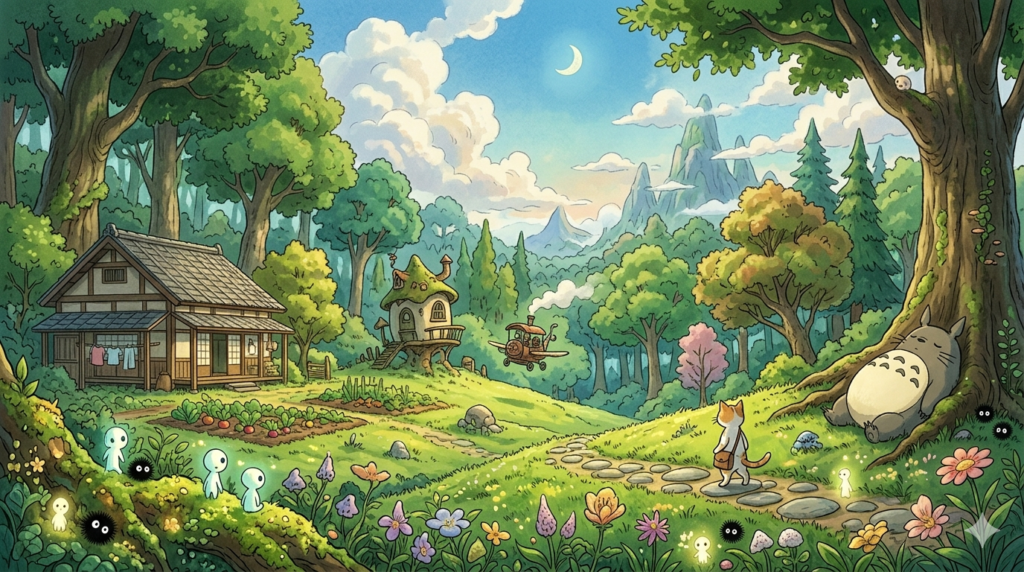
🌙 When Code Attempts to Take a Dream: Why AI Will Never Be Studio Ghibli
We all wish to be part of the magic of Studio Ghibli ourselves.
Recall the first time you witnessed Totoro waving, or when Spirited Away’s train chugged through flooded tracks?
Those shots weren’t simply lovely — they were human.
No matter how hard it tries, AI can’t produce that sort of soul. It’s seductive to think that creativity is merely another challenge technology will eventually “solve.”
Feed a few words into an AI art generator, and voilà: a stunning view — floating islands, luminous skies, mythical creatures — something that resembles a dream.
But there’s an uncanny vacuum in it.
The colors are exquisite, the light heavenly, the form flawless… and yet, it doesn’t breathe.
Then you see a Studio Ghibli movie — Spirited Away, My Neighbor Totoro — and suddenly the world feels alive again. The grass sways in unseen breeze. The food radiates warmth. A train speeds through deluged tracks in silence, and that silence speaks louder than a thousand words.
That is the distinction between Studio Ghibli and AI generation: one mimics beauty, the other understands it.
✏️ The Soul in the Sketch
Studio Ghibli, founded by the great Hayao Miyazaki, has never been about perfection but about presence.
Every frame is penned by human hands — hands that fatigue, tremble, and falter. You can witness it in the pencil strokes that waver slightly, in the colors that spill beyond the edges. These small flaws are confessions of life.
Miyazaki once said, “Hand-drawing gives me the chance to feel the soul of what I’m creating.”
AI doesn’t feel. It predicts. It guesses the next pixel based on a million others it’s seen before. Its beauty is borrowed — an echo of human emotion without the heartbeat behind it.
It’s the visual equivalent of a cover band that knows all the notes but none of the pain that birthed them.
And when AI makes a mistake, it’s not charming — it’s empty. The final product doesn’t quite seem right.
⚙️ AI’s Mirage of Creativity
Let’s be honest — AI paintings are amazing. The technology can merge styles, create new scenery, and imagine entire worlds faster than any human could.
It can even transform real photos into “Ghibli-like” images — but here’s the uncomfortable truth:
AI doesn’t create; it compiles.
Each picture it generates is pieced together from the ghosts of human-made art. It’s trained on massive collections of authentic artists’ work — people who spent years developing a voice, an identity, a spirit — and yet AI is praised for reassembling those voices into something “original.”
But originality requires emotion. It demands memory, conflict, compassion — all the things no algorithm can simulate.
Where AI emulates, Ghibli moves.
🍃 The Ghibli Philosophy: Ma, Wabi-Sabi, and the Art of Being Still
Miyazaki often speaks of ma — the Japanese concept of emptiness, the stillness between moments.
It’s the silence that makes sound meaningful.
In My Neighbor Totoro, there’s an entire scene where nothing happens — just wind blowing through trees. No action. No dialogue. Just being.
Modern AI art fears stillness. It optimizes for output, for efficiency. It wants to fill every space.
But Ghibli knows that art isn’t about filling; it’s about feeling.
Then there’s wabi-sabi — the beauty of imperfection.
In AI’s world, imperfection is a bug to fix.
In Miyazaki’s world, it’s what makes life real.
The smudge of pencil in a Ghibli sketch carries more soul than a million pixel-perfect AI renders.
🔮 When Machines Chase Magic
If you’ve seen Spirited Away, you’ll remember Chihiro’s quiet train ride through the flooded plains.
The reflection of the sky ripples below, faceless spirits sit beside her, and time stands still. Nothing “happens,” yet your heart aches.
AI might recreate that image — but it can’t understand why it hurts.
Because that moment isn’t about trains or ghosts or composition. It’s about loneliness, change, and the bittersweet pull of growing up.
AI can map emotion, but it can’t feel it.
It can simulate imagination, but it can never dream.
Its art is a shadow without a source.
⚡ The Efficiency Trap
The real danger isn’t that AI art is soulless — it’s that it’s convenient.
Fast, cheap, and tireless — perfect for studios chasing profit over poetry.
But Ghibli’s magic depends on slowness. Every raindrop, every lantern flicker, every gust of wind is animated with devotion.
In Ghibli’s world, efficiency kills intimacy.
When Miyazaki was once shown an AI-generated animation, he replied sharply:
“I strongly feel that this is an insult to life itself.”
He wasn’t being dramatic — he was defending the idea that art is alive, and life cannot be automated.
🌧️ Why We Still Need Dreamers
AI can create a lullaby, but it will never know what it feels like to sing a child to sleep.
It can paint a sunset, but it will never understand why that sunset makes us cry.
It can describe love, but it will never love.
Miyazaki’s work endures because it captures what makes us human — the fragile, fleeting emotions we can’t quantify.
When Totoro roars, it’s childhood joy.
When Howl’s castle walks, it’s the messy, patchwork survival of the human heart.
We watch Ghibli not for its beauty — but for its tenderness.
🕊️ The Future Isn’t AI vs. Art — It’s Soul vs. Simulation
AI isn’t the villain. It’s a tool — a brilliant, useful one. It can expand creative horizons, help visualize ideas, even inspire artists.
But it will never replace the messy, soulful process of human creation.
The danger comes when we start believing that emotion can be programmed, that creativity can be mass-produced, and that imagination is just data waiting to be rearranged.
Because when we believe that — the dream dies.
🌕 Closing: What AI Can’t  AI can mimic style but not spirit.
It can copy form but not feeling.
Studio Ghibli’s worlds remind us that the magic of creation lies not in how fast or perfectly we can make something — but in how deeply we can make someone feel.
AI may one day paint the perfect sunset — but it will never know why it makes us weep.
For real art isn’t born of data; it’s born of longing, memory, and the delicate ache of being alive.
Studio Ghibli’s worlds breathe because they carry fingerprints — tired hands, hopeful hearts, and dreamers who still believe that every leaf deserves attention, every silence deserves to speak.
AI can recreate Ghibli’s colors, mimic its softness, and trace its charm — but it can’t capture the invisible pulse behind it. The hesitation in a line. The pause before a tear. The warmth that turns a sketch into a feeling.
Miyazaki once said he draws by hand because it lets him “feel the soul of what I’m creating.”
That’s the heart of it.
AI produces art that exists.
Studio Ghibli creates art that lives.
We can let machines assist us, maybe even inspire us — but only humans can make art that matters.
Because it takes a heart to see the sacred in the mundane. It takes a soul to make a scene unforgettable.
So let algorithms calculate beauty. Let them chase perfection.
But as long as there’s one trembling hand sketching a sky, one dreamer taking her time to create in a world obsessed with speed —
the wonder of Studio Ghibli will never belong to code.
Not to perfection.
But to the human heart that still dreams. 💫