
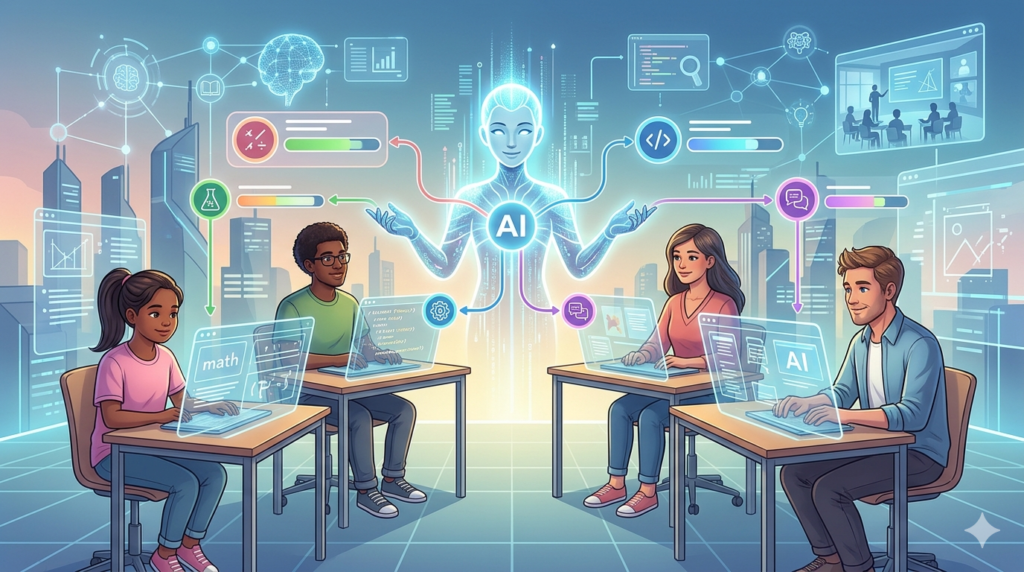
E-learning has come a long way—from boring slide decks and robotic videos to interactive courses and virtual classrooms. But even with all this progress, one major problem still exists: most online learning is not truly personalized.
Enter Artificial Intelligence (AI)—the real game-changer.
AI in e-learning is transforming how people learn, what they learn, and how fast they learn. Instead of forcing every learner down the same path, AI adapts content based on individual needs, behavior, and performance. In short, it finally treats learners like humans—not statistics.
In this blog, we’ll explore how AI is reshaping e-learning, why personalized education matters, and what the future looks like for learners, educators, and organizations.
What Is AI in E-Learning?
AI in e-learning refers to the use of artificial intelligence technologies—such as machine learning, natural language processing, and predictive analytics—to improve digital learning experiences.
AI-powered systems can:
-
Analyze learner behavior
-
Adapt content in real time
-
Provide personalized feedback
-
Predict learning gaps
-
Automate administrative tasks
Think of AI as a smart assistant that learns about the learner while helping the learner learn.
Why Personalized Learning Matters More Than Ever
Here’s the hard truth: one-size-fits-all education doesn’t work.
Every learner is different. Some learn fast, some need repetition. Some prefer videos, others love reading or quizzes. Traditional e-learning platforms treat everyone the same—and that’s exactly why engagement drops.
Benefits of Personalized Learning:
-
Higher engagement
-
Faster skill development
-
Better knowledge retention
-
Reduced learner frustration
-
Improved completion rates
AI makes personalization scalable—something human instructors alone simply can’t do at scale.
How AI Personalizes the Learning Experience
This is where things get exciting.
1. Adaptive Learning Paths
AI analyzes how learners interact with content and adjusts the learning path accordingly. If someone struggles with a concept, AI slows things down. If they excel, it skips the basics.
No wasted time. No unnecessary boredom.
2. Intelligent Content Recommendations
Just like Netflix suggests your next binge, AI recommends lessons, quizzes, or resources based on learner progress and interests.
Learning, but make it algorithmic—in a good way.
3. Personalized Assessments
AI can generate customized quizzes based on strengths and weaknesses, ensuring assessments actually measure learning—not luck.
4. Real-Time Feedback
Instant feedback helps learners correct mistakes immediately, reinforcing understanding and confidence.
AI-Powered Tools Transforming E-Learning
AI isn’t theoretical anymore—it’s already embedded in modern learning platforms.
Key AI Tools in E-Learning:
-
AI Tutors & Chatbots – 24/7 learner support
-
Learning Analytics Dashboards – Track progress and predict outcomes
-
Speech Recognition – Improve language learning
-
Natural Language Processing (NLP) – Smarter content interaction
-
Predictive Analytics – Identify drop-off risks early
These tools help educators focus on teaching while AI handles the heavy lifting.
AI in Corporate Training and Upskilling
Corporate learning is one of the biggest winners here.
Why Businesses Love AI in E-Learning:
-
Personalized onboarding
-
Faster employee upskilling
-
Targeted training programs
-
Performance-based learning paths
-
Higher ROI on training investments
AI identifies skill gaps and recommends training before performance drops. That’s not just smart—it’s strategic.
AI and Data-Driven Learning Decisions
Data is the fuel, AI is the engine.
AI collects and analyzes massive amounts of learner data to:
-
Identify trends
-
Predict outcomes
-
Improve course design
-
Optimize learning strategies
Educators and organizations no longer guess what works—they know.
Role of AI in Student Engagement and Motivation
Engagement is the biggest challenge in e-learning. AI tackles it head-on.
How AI Boosts Engagement:
-
Personalized challenges
-
Smart reminders and nudges
-
Gamified learning paths
-
Adaptive difficulty levels
When learners feel seen and supported, motivation skyrockets.
AI Does Not Replace Teachers—It Empowers Them
Let’s clear the air: AI is not here to replace educators.
Instead, it:
-
Reduces repetitive admin work
-
Automates grading and tracking
-
Provides insights into learner needs
-
Frees time for meaningful interaction
Teachers become mentors and facilitators—not data-entry machines.
Ethical Considerations and Challenges of AI in E-Learning
Okay, real talk—AI isn’t perfect.
Key Challenges:
-
Data privacy concerns
-
Algorithm bias
-
Over-reliance on automation
-
Accessibility gaps
The solution? Responsible AI design, transparency, and human oversight. AI should support learning—not control it.
The Future of AI in Personalized Education
We’re just getting started.
What the Future Looks Like:
-
Hyper-personalized learning journeys
-
AI-driven skill forecasting
-
Emotional intelligence in learning systems
-
Voice-enabled learning assistants
-
Seamless integration with AR and VR
The future of education is adaptive, intelligent, and learner-first.
Why AI-Powered E-Learning Is Here to Stay
AI isn’t a trend—it’s a foundation.
As technology evolves and learner expectations grow, AI-powered e-learning will become the norm, not the exception. Institutions and organizations that embrace it early will lead the future of education.
Those that don’t? Well… good luck competing.
Final Thoughts: Personalized Learning Is the Future
AI in e-learning is redefining education by making it personal, efficient, and engaging. It respects individual learning styles, adapts in real time, and delivers better outcomes—for learners and educators alike.
Education doesn’t need to be rigid to be effective. With AI, learning finally meets learners where they are.
And honestly? That’s the future we should’ve had already.